Is It Safe to Drive? Check This First
Before you worry about which part it is, decide if the car should move. Here is how we sort it on the phone.
| What You Notice | What We Tell You |
|---|---|
| Clunk plus loose, wandering or shaky steering | Park it. That points at a ball joint or tie rod end. Do not drive it to a shop |
| Clunk plus the car pulls hard to one side | Park it until a corner is checked. Something is bent or loose |
| New clunk right after a hard pothole hit | Drive gently and get it inspected soon |
| Light clunk over small bumps, steering feels normal | Usually safe for short trips. Book a check this week |
| Clunk only on slow, tight turns | Often a CV joint. Get it checked before it gets louder |
AAA gives the same advice after a pothole hit. Listen for any new or unusual noise or vibration, and if something seems wrong, get the car inspected as soon as possible (AAA Newsroom, March 1, 2022). We are mobile, so a car that should not be driven can be checked for suspension wear in your driveway.
The 7 Parts That Clunk, in the Order We Check Them
Most pages list these in random order. We list them the way we work a real call. The quick checks come first, the safety parts get the closest look, and nothing gets replaced until we can see or feel the play on the car.
| # | Part | The Clue | How Serious |
|---|---|---|---|
| 1 | Sway bar links | Sharp knock over small bumps and rough pavement, often at low speed | Noisy, rarely urgent. One of the cheaper fixes |
| 2 | Sway bar bushings | Dull thud or creak over bumps and in turns | Low. Often done with the links |
| 3 | Control arm bushings | Dull clunk when the car loads up, like braking or a dip | Medium. They let the wheel shift |
| 4 | Strut mount or top mount | Thump from up high near the hood or fender, sometimes when turning the wheel | Medium |
| 5 | Worn shock or strut | Bouncy ride, nose dives on braking, a knock on big hits | Medium. Longer stops and worn tires |
| 6 | Ball joints | Clunk over bumps plus loose steering or uneven tire wear | High. A failed joint can drop the wheel |
| 7 | Tie rod ends | Knock when you start to turn, loose or wandering steering | High. They connect your steering to the wheel |
Rule out the free stuff first. Empty the trunk. A loose jack, a toolbox or a spare tire that is not tied down can clunk over every bump. A loose heat shield under the car rattles more than it clunks, but it fools people too.
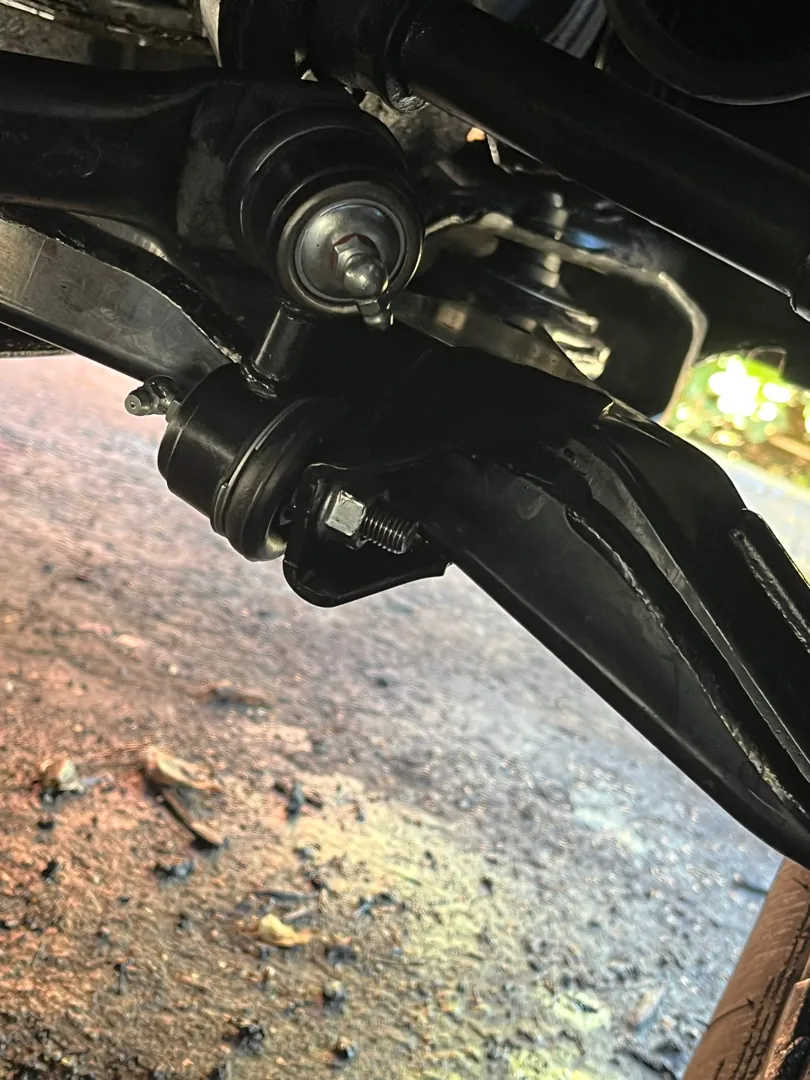
1. Sway bar links. These short rods tie the sway bar to the suspension on each side. When their small joints wear, the bar knocks over uneven pavement. The top pages name it as the most common cause. It is noisy but not usually a danger on its own.
2. Sway bar bushings. Rubber blocks hold the bar to the frame. When they dry out, you get a thud or a creak. Cheap parts, and often replaced in the same visit as the links.
3. Control arm bushings. The control arm holds the bottom of the wheel. Its rubber bushings crack with age and heat. Then the arm shifts under load and you hear a dull clunk. Left long enough, they also wear out tires.
4. Strut mounts. The top of the strut bolts to the body through a rubber mount and often a bearing. A worn mount thumps from up high. If you also feel a bind or pop when you turn the wheel parked, the bearing is a good bet.
5. Shocks and struts. A worn shock tends to bounce more than it clunks. But a broken mount bolt or a strut that bottoms out will knock on big bumps. If the car keeps bouncing after a dip, that is your clue.
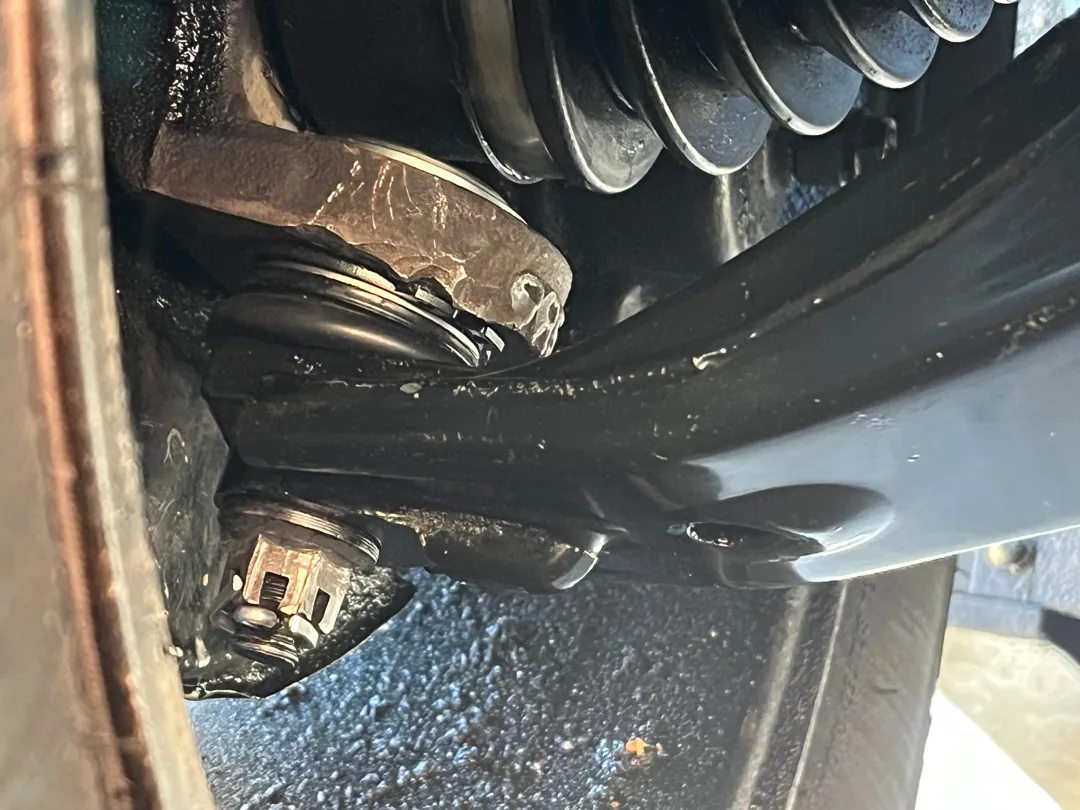
6. Ball joints. These are the pivots your front wheels turn on. A worn one clunks over bumps, and the steering starts to feel vague. This is the part that worries us most. If it lets go, the wheel can fold under the car. That is why loose steering plus a clunk means you park it.
7. Tie rod ends. These link the steering rack to each wheel. A worn end knocks when you first turn the wheel and lets the car wander on the road. It also chews the edge of the tire. Like ball joints, this is a safety part.
Two more that show up now and then. A worn CV joint clicks or clunks on slow, tight turns. And loose brake parts, like a caliper bolt or worn slide pins, can knock over rough pavement. If yours clunks mostly when braking, our brake repair page covers what we check there.
Where and When It Clunks Tells Us a Lot
The sound alone is not enough. Most clunks sound the same to most people. When and where it happens narrows it fast.
| When It Clunks | Where We Look First |
|---|---|
| Over every small bump, front end | Sway bar links, then sway bar bushings |
| Only one front corner | That corner's link, ball joint, control arm bushings and strut mount |
| When you start to turn the wheel | Tie rod ends, then strut mounts |
| Slow, tight turns like a parking lot | CV joint, then strut mount bearing |
| When braking or pulling away | Control arm bushings, then loose brake parts |
| Speed bumps and driveway dips | Strut mounts, shocks and struts, then sway bar links |
| Rear end only | Rear shock mounts, rear sway bar links, loose cargo |
One warning. Sound travels through the body. A clunk you hear on the right can come from the left. That is why a good mechanic checks both sides on the car instead of guessing from the driver's seat.
What to Tell Your Mechanic
None of the top pages cover this, and it saves you money. The faster we can find the clunk, the less diagnosis time you pay for. Before you call, write down these answers.
- Which corner? Front or rear, left or right, or you cannot tell.
- What speed? Parking lot speed, around town or freeway.
- Straight or turning? Does it happen with the wheel straight, or only in a turn?
- Braking? Does it clunk when you brake or pull away?
- Since when? Did it start after a pothole, a curb or a recent repair?
- Steering feel? Any looseness, pull or shake in the wheel?
- Tires? Run a hand over the front tires. Wear on one edge points to a steering or suspension part.
If you can, record a short video with sound while someone drives over a bump. It helps more than any description.
Why Valley Roads Find Worn Parts
Bumps do not cause most clunks. They reveal them. A tired bushing or link can hide on smooth pavement and show up the first time you hit a rough patch.
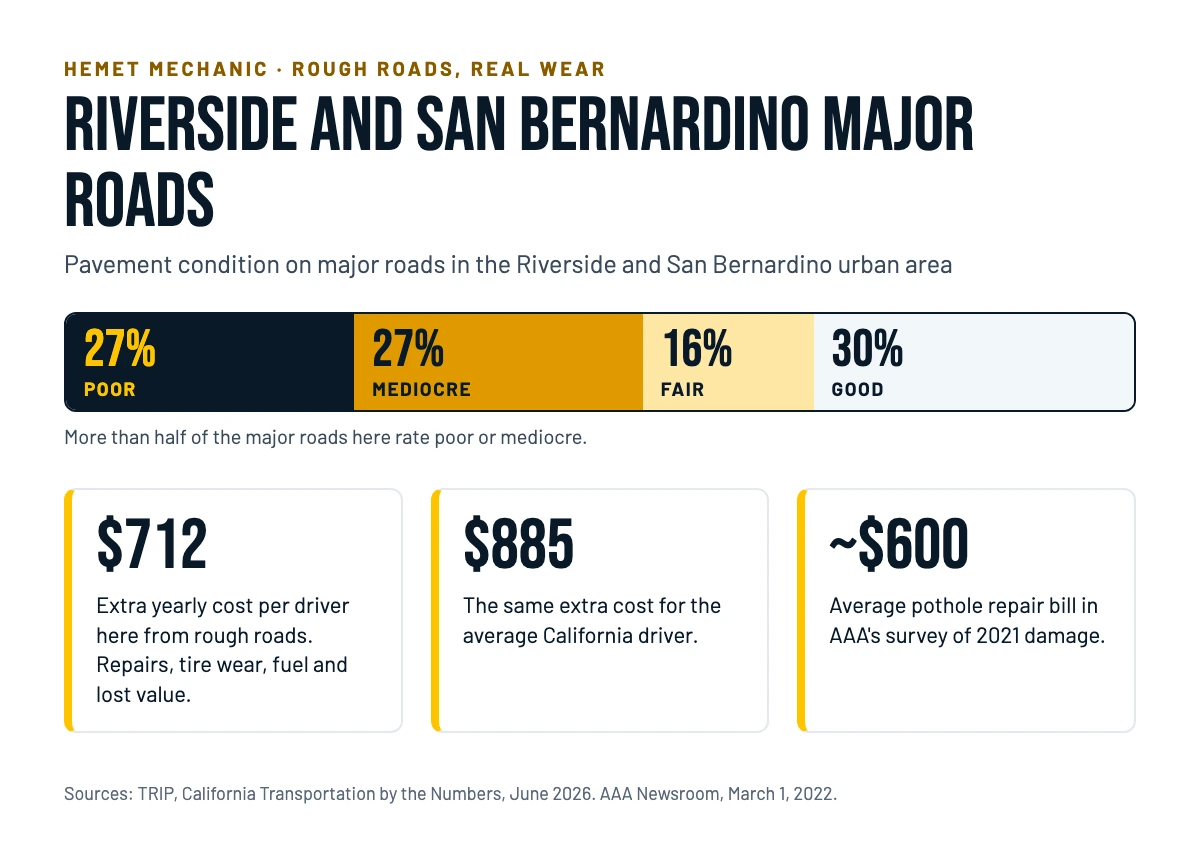
Rough patches are easy to find here. TRIP, a national transportation research group, rates 27 percent of major roads in the Riverside and San Bernardino urban area as poor and another 27 percent as mediocre. Only 30 percent rate good. TRIP puts the extra cost of driving on those roads at $712 a year for the average driver here, against $885 for the average California driver. That cost covers extra repairs, tire wear, fuel and lost vehicle value (TRIP, California Transportation by the Numbers, June 2026).
Potholes are the worst of it. In AAA's survey of 2021 damage, 1 in 10 drivers needed a repair after a pothole hit, at an average of almost $600 per repair. AAA says tires, wheels and suspension take the brunt of it (AAA Newsroom, March 1, 2022).
How We Find the Clunk on Your Car
Here is how a suspension call works with us, as posted on our site on October 19, 2026.
- Call with the symptom. Quotes are free. Tell us the car and your answers from the list above, and we will tell you what it likely is.
- We confirm it on the car. The car goes up on stands. We check each joint, link and bushing for play and look at every boot. The worn part is confirmed before anything is replaced.
- You see the part. Ask for your old parts back. California gives you that right if you ask before you approve the repair (Bureau of Automotive Repair).
- Most jobs finish in one visit in your driveway. Anything bigger than a day moves to our garage at 325 Elmwood Ave and comes back finished.
Before you pay anyone for suspension work, check two things. First, look up your VIN on NHTSA's recall search. Your 17 character VIN is on the lower left of the windshield and on your registration. If it shows an open recall on a suspension or steering part, call the dealer before you pay anyone. Second, get the estimate in writing. California's Bureau of Automotive Repair says a licensed shop gives you an estimate before work starts, and must get your OK before adding any repair (BAR, auto repairs).
What It Costs With Us
Suspension pricing depends on the car and the part, so we quote it by the job. Here is what is posted on our price list on October 19, 2026.
- Diagnosis is $150 an hour if you want the clunk found in person before a quote.
- Every repair carries our 3 year warranty on parts and labor.
- We do not service air bag suspension or install lift kits. Everything else underneath, we handle.
Here is a worked example of how a bill adds up, not a quote. If a repair books 1.5 hours of labor, labor at our posted rate is 1.5 times $150, or $225, plus the parts. On a clunk that turns out to be a sway bar link, the parts are often the small part of the bill. On a ball joint that has been knocking for months, there may be a tire to add. Catching it early is the cheap way out.
For the big picture on which repairs get expensive when small ones wait, see our guide to the most expensive car repairs.
What the Top Pages Get Wrong
We read the pages that rank for this question on October 18, 2026. They name the right parts. The best of them, from ER Collision in Huntington Beach and Ochoa's Tire Service in Long Beach, also sort the noise by where it comes from. But none of them gives a single price, a table you can scan on your phone, or a list of what to tell the mechanic. The Huntington Beach page has no date at all.
The bigger miss is the order. A clunk is not a guessing game. The cheap and common parts get checked first because they are quick to rule out. The safety parts get the closest look because they are the ones that can hurt you. And no part should be replaced until the play is found on the car. Swapping parts on a guess is how a small problem becomes a big bill.
Clunking Over Bumps FAQ
Is it safe to drive with a clunking noise?
It depends on what comes with it. A clunk with normal steering is usually a sway bar link or bushing and is fine for short trips until it is checked. A clunk with loose, wandering or shaky steering points at a ball joint or tie rod end. Park the car and have it checked where it sits.
What does a ball joint sound like when it is bad?
A worn ball joint makes a clunk or knock over bumps, often from one front corner. It can also creak when you turn the wheel. Loose steering and wear on the edge of the tire usually come with it.
Will a bad tie rod make a clunking noise?
Yes. A worn tie rod end often knocks when you first turn the wheel or go over a bump while turning. The car may also wander and the front tires can wear on one edge.
How do you diagnose a suspension clunk?
Note where and when it happens, then put the car on stands and check each part by hand for play. Sway bar links, bushings, ball joints, tie rod ends and strut mounts all get checked on both sides, because the sound can travel across the car.
Can bad struts cause a clunking noise?
They can. A worn strut usually makes the car bounce more than it clunks. But a worn strut mount, a broken mount bolt or a strut that bottoms out will knock on bigger bumps like speed bumps and driveway dips.
Why does my car clunk after hitting a pothole?
A hard hit can bend or loosen a suspension part, or finish off one that was already worn. AAA says tires, wheels and suspension take the brunt of pothole damage. If you hear a new noise after a hit, get it checked soon.
Sources
- TRIP, California Transportation by the Numbers, June 2026, opened October 18, 2026
- AAA Newsroom, potholes pack a punch as drivers pay $26.5 billion in related vehicle repairs, March 1, 2022, opened October 18, 2026
- California Bureau of Automotive Repair, auto repairs, opened October 18, 2026
- NHTSA, check for recalls, opened October 18, 2026
- ER Collision, what causes clunking noise over bumps, undated, opened October 18, 2026
- Ochoa's Tire Service, clunking noise over bumps, April 2026, opened October 18, 2026
- Hemet Mobile Mechanic price list and suspension page, our own posted rates and job photos as of October 19, 2026
Hemet Mobile Mechanic fixes cars in driveways across Hemet and the San Jacinto Valley. Hearing a clunk? Call (951) 474-1277 with the car and when it happens. We come to the car.