When a Flush Is Needed and When It Isn't
"Needed" has a plain test. The book calls for it, the fluid fails a test, or the car is telling you something. Anything else is a maybe.
The middle column comes from Cars.com and RepairPal. The last column is Hemet Mechanic's shop judgment, not a law.
| Your Situation | What the Sources Say | The Call |
|---|---|---|
| Your manual lists an interval and you're past it | Cars.com says to go by the time or the miles, whichever comes first | Needed. Book it. |
| Your manual lists no interval and the fluid is clear | RepairPal says a flush is usually not necessary then | Not yet. Ask for a fluid test at each brake check. |
| A tester reads about 3% water | Cars.com calls that getting near the danger zone | Needed soon. |
| Dark fluid with debris, a squishy pedal or longer stops | RepairPal lists these as signs the fluid has broken down | Get the brakes checked now. A flush may be part of the fix. |
| A caliper, hose or master cylinder was just replaced | Bleeding pumps new fluid through the lines to clear out air, per RepairPal | A bleed comes with that repair. A full flush is a separate choice. |
| You tow or drive in severe conditions | The 2012 Nissan Leaf schedule cuts the interval from 2 years to 1 for severe service, per Cars.com | Use the severe schedule if your manual has one. |
| It's offered at every visit, with no reading and no page from the manual | RepairPal says some shops treat flushes as a profit center | Not needed on that alone. Ask the five questions further down. |
Cars.com writer Rick Popely lands in the middle. He says a flush every 2 or 3 years is probably too often unless the maker asks for it, and he suggests 4 or 5 years. He also says not to wave off a mechanic's advice as salesmanship, since mechanics see what neglected fluid does (Cars.com, 2018).
What the Carmakers Put in Writing
The spread is wide. The fluid is much the same, and the books are not.
| Maker or Model | Brake Fluid Interval | Where It's From |
|---|---|---|
| Mercedes-Benz | Every 2 years or 20,000 miles | Cars.com, 2018 |
| Volkswagen, most models | Every 2 years at any mileage | Cars.com, 2018 |
| 2011 Honda Civic | Every 3 years | Honda owner's manual |
| Subaru | Every 30,000 miles | Cars.com, 2018 |
| 2012 Nissan Leaf | Every 2 years or 30,000 miles. Every year or 15,000 miles for severe service | Cars.com, 2023 |
| Chevrolet, most vehicles | 150,000 miles or 10 years | Cars.com, 2018 |
| 2012 Toyota Camry | None through 120,000 miles or 12 years. Inspections only | Cars.com, 2023 |
| Many Ford, Chrysler and Toyota vehicles | Not listed as a regular item | Cars.com, 2018 |
Those rows come from articles dated 2018 and 2023 and from an older manual, so treat them as examples. Your own manual is the one that counts. The California Bureau of Automotive Repair says the manual holds the maker's recommended maintenance schedule, and that you can get a copy from the maker's website (BAR, Maintenance and Repairs).
What Water Does to Brake Fluid
Brake fluid pulls water out of the air. Cars.com points out that the reservoir is often half full of air, and air always holds some water.
Water lowers the boiling point. The federal brake fluid standard, FMVSS 116, sets two floors for each grade. One is for new fluid. The other is for fluid the lab has let absorb water. DOT 3 has to hold 401 F new and only 284 F wet. DOT 4 goes from 446 F to 311 F (49 CFR 571.116).
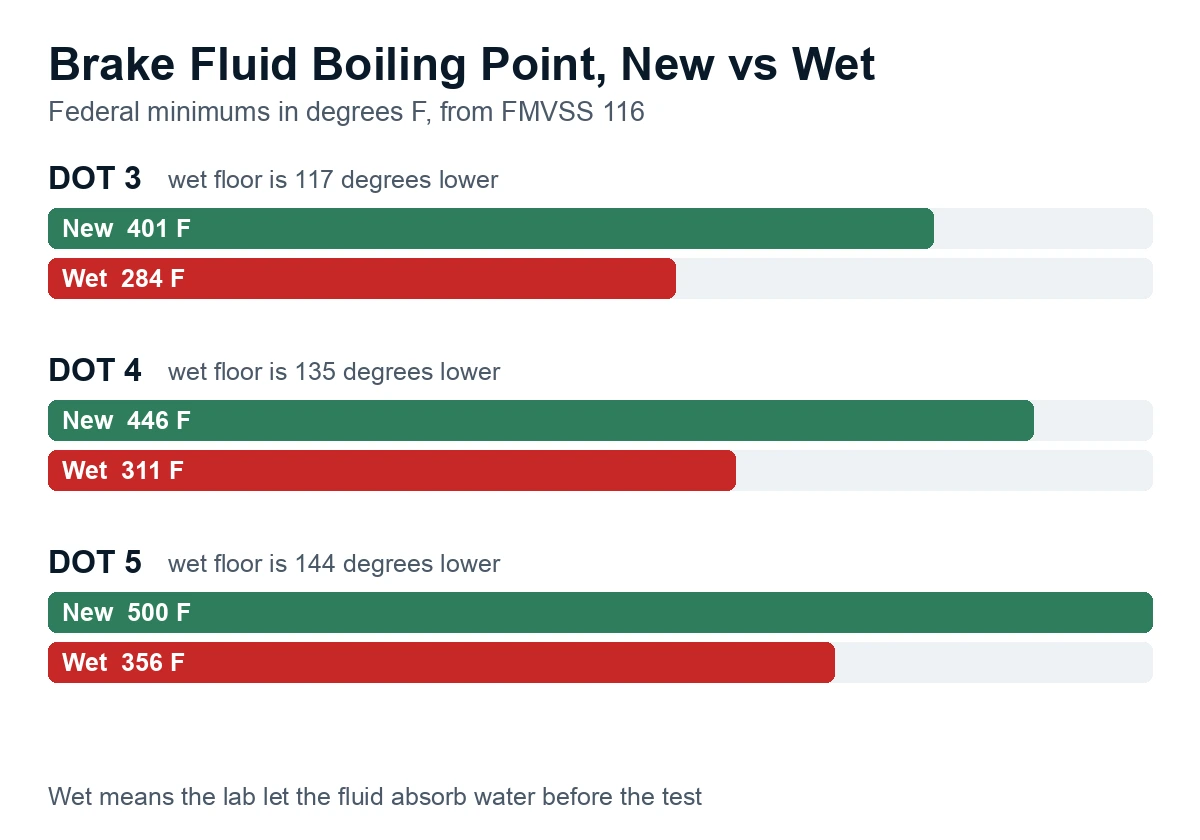
Hot brakes boil wet fluid sooner. Cars.com says that can weaken the pedal during repeated hard stops, or even cause brake failure. Water also rusts brake parts from the inside. Popely's money point is simple. New fluid costs less than corroded brake lines or a master cylinder.
You can measure it. Cars.com says some inspections include a water test, and that simple testers sell for less than $10. It also warns the cheap ones may carry no accuracy rating, so a shop tester is the better read.
Flush, Bleed or Top Off
Three jobs get mixed up at the counter.
- Top off. Fluid gets added to the reservoir. BAR counts fluid top offs as regular maintenance. The old fluid in the lines stays where it is.
- Bleed. Enough new fluid gets pumped through the lines to push out air, one wheel at a time, per RepairPal.
- Flush. All the old fluid gets replaced with new, often with a machine, per RepairPal.
The bottle tells you how touchy this fluid is. Federal rules make every container warn you to keep it tightly closed so it won't absorb moisture. The label also has to say that dirt, water or petroleum products in the fluid may lead to brake failure or costly repairs (FMVSS 116, S5.2.2.2). So the half used bottle that's been open on a garage shelf is the wrong one to pour in.
Use the grade your manual names. Popely notes that cars don't all take the same one.
Five Questions Before You Say Yes
- Where does my manual call for this? Show me the page.
- Did you test the fluid, and what did it read?
- Is this a bleed or a full flush?
- Which fluid grade are you using, and does it match my manual?
- Will the estimate and the invoice list it as its own line?
California law backs you up. BAR says a shop must give you an estimate that shows the expected cost, and that you must authorize repairs before work begins. The final invoice has to list all repairs performed and the parts supplied. Under Business and Professions Code 9884.9, no charges can build up before you give the go ahead (Section 9884.9). Section 9884.7 lets the state suspend or revoke a shop's registration over statements that are untrue or misleading (Section 9884.7).
This fight has history in California. In December 2013, Ratchet+Wrench reported that BAR looked into fluid services after a spike in complaints. A state spokesperson told the magazine the investigation found multiple repair shops charging for unneeded fluid services based on untrue claims. The same spokesperson said shops can't tell you the maker recommends something if that's not true. BAR chose not to write new rules (Ratchet+Wrench).
Hemet's Dry Air Helps a Little
Hemet has a semi-arid climate and gets about 11.75 inches of rain a year (Wikipedia, Hemet). Cars.com says air holds more water in humid climates. So fluid here has less to soak up than fluid in a damp place.
That's no free pass. The interval in your manual doesn't change with the weather. And heat is where wet fluid gets caught out. Highway 74 has a long drop back into the valley, which is covered in Worn Brake Pads, Book at 1/8 Inch.
Hemet Mechanic lists brake fluid changes on its services page as call for quote, next to brake repairs. Pad and rotor pricing is laid out in Brake Job Prices in Hemet.
Last Few Questions
- Is a brake fluid flush really necessary?
- Yes, when your owner's manual lists an interval and you've reached it, or when a test shows the fluid has gone bad. RepairPal says that if the maker doesn't recommend a flush and the fluid is clear, it's usually not necessary.
- How critical is a brake fluid flush?
- It matters most once the fluid has taken on water. Under FMVSS 116, DOT 3 fluid must boil no lower than 401 F new and 284 F wet. Cars.com says water in the fluid can weaken the pedal during repeated hard stops and rust brake parts.
- Can brake fluid last 10 years?
- On some cars the book says so. Cars.com reported in 2018 that most Chevrolet vehicles can go 150,000 miles or 10 years without a change. Mercedes-Benz and Volkswagen call for one every 2 years, so check your own manual.
- What happens if I never change my brake fluid?
- The fluid keeps absorbing water from the air. Cars.com says that lowers its boiling point and can cause rust and leaks in the brake system. Replacing fluid costs less than replacing corroded brake lines or a master cylinder.
- Do you need to flush brake fluid when changing pads?
- Not always. Cars.com says a mechanic may flush the lines during a brake job, and its writer Rick Popely suggests pairing a fluid change with other brake work. A pad job on its own doesn't call for one unless the manual or a test says the fluid is due.
- How much does it cost for a brake fluid flush?
- It depends on the vehicle and the shop. Hemet Mechanic lists brake fluid changes as call for quote, so you get a price for your car before any work starts.
Links We Used
- Cars.com, Does Brake Fluid Need to Be Changed, Rick Popely, published January 2018, accessed November 2026
- Cars.com, How Often Do I Need to Change My Brake Fluid, Rick Cotta, published August 2023, accessed November 2026
- Honda, 2011 Civic Sedan Owner's Manual, Brake Fluid, accessed November 2026
- 49 CFR 571.116, FMVSS 116 Motor Vehicle Brake Fluids, accessed November 2026
- RepairPal, Brake Bleed vs. Brake Flush, Stephen Fogel, published June 2018, accessed November 2026
- California Bureau of Automotive Repair, Maintenance and Repairs, accessed November 2026
- California Business and Professions Code 9884.9 and 9884.7, accessed November 2026
- Ratchet+Wrench, The Impact of California's Wallet Flushing Trend, published December 2013, accessed November 2026
- Wikipedia, Hemet, California, accessed November 2026
- Hemet Mobile Mechanic services page, our posted services, November 2026
More Like This
- Brake Job Prices in Hemet, 2026, Per Axle and Per Car
- Worn Brake Pads, Book at 1/8 Inch, Stop Driving at Grinding
- Oil Change Every 5,000 to 10,000 Miles in Hemet, Not 3,000
We do brake work in driveways across Hemet and the San Jacinto Valley, 7 days a week. If a shop told you the fluid is due and you'd like a second read, call (951) 474-1277. We'll quote it before we start.