Find the Number for Your Car
There's no single answer for every car. The right interval comes from the company that built your engine, and it's printed in two places.
- The owner's manual or maintenance guide. It lists the miles and the months, plus a shorter schedule for hard driving.
- The oil life monitor. Most newer cars have one on the dash. It watches how you drive and counts down to the next change.
The general guides land in the same range. AAA says most engines now go 5,000 to 7,500 miles. It puts conventional oil at about 5,000, a synthetic blend at 6,000 and full synthetic at 10,000 to 15,000 (AAA). Toyota's car care page says many newer cars can go 5,000 to 7,500 miles, and some up to 15,000 (Toyota).
Ford's oil life monitor can run as long as 10,000 miles or a year. It also adjusts for engine temperature, idling and towing, according to Ford's oil life FAQ.
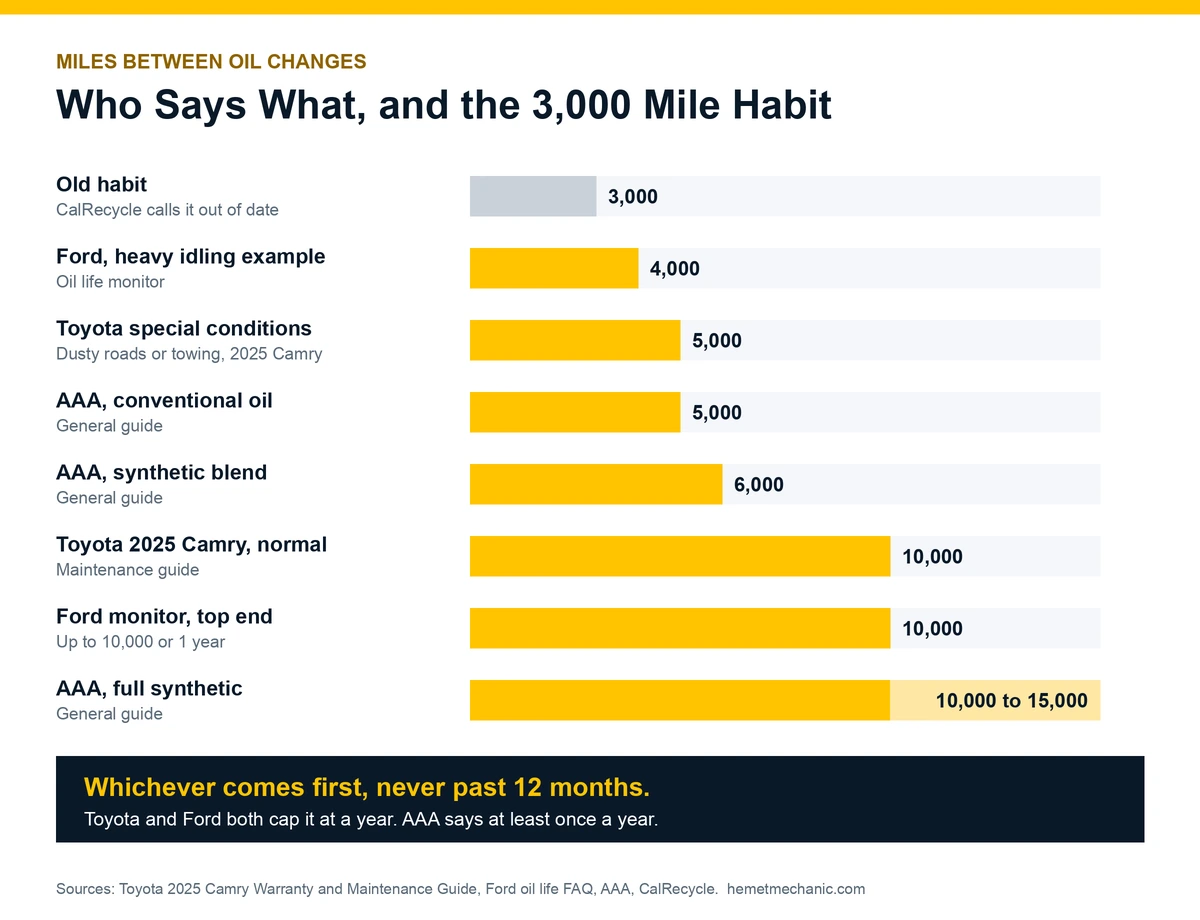
So where did 3,000 come from? It was the standard for older engines and older oil. California's recycling agency, CalRecycle, now runs a campaign called Check Your Number. It says the old 3,000 mile standard is out of date and no longer applies to most cars (CalRecycle). Some cars, even older ones, can go 5,000, 7,500, 10,000 or even 15,000 miles.
Does Hemet Heat Put You on the Severe Schedule?
This is where most advice goes wrong for the Valley. It gets hot here. NOAA's climate normals for the Hemet station show an average of 121 days a year at 90 degrees or more, and 41 at 100 or more (NOAA). So it's easy to assume every car in town belongs on the short schedule.
Read your own guide before you decide. Toyota's 2025 Camry guide lists its special operating conditions. Two of them change the oil schedule.
- Driving on dirt, dusty or muddy roads, or on roads with melted snow.
- Towing, using a car top carrier, or carrying heavy loads.
Heat isn't on that list. If you drive primarily under one of those two conditions, Toyota wants new oil and a filter every 5,000 miles or six months, no matter which oil you use. And it says to use that schedule only if the majority of your driving happens that way. A few dusty weekends don't count.
AAA's list is wider. It names trips of 5 miles or less, very hot, cold or dusty climates, steady stop and go driving, and towing or heavy loads. AAA also says newer cars often skip a separate severe schedule because the oil life monitor shortens the interval on its own.
What Actually Counts in the Valley
For a Hemet driver, these habits are worth a close look.
| How You Drive | Does It Shorten the Interval? |
|---|---|
| Freeway commute on paved roads, summer heat | Usually not by itself. Follow the normal schedule or the monitor. |
| Dirt roads or a dusty job site most days | Yes. That's a Toyota special condition and an AAA severe condition. |
| Towing a boat or trailer, like a run up to Diamond Valley Lake | Yes, if you tow often. Toyota and AAA both list it. |
| Lots of idling with the AC running | It can. Ford says heavy idling may call for a change at 7 months or 4,000 miles. |
| Mostly short trips under 5 miles | Yes. Trips of 5 miles or less are on AAA's severe list. |
A car on the dash monitor already handles most of this. Trust the percentage, change it when it asks, and get the monitor reset after every change.
The 12 Month Limit
Miles aren't the only clock. Oil ages in the pan even when the car sits.
Toyota's guide says to replace the oil and filter after 12 months, even when the maintenance reminder hasn't come on. It warns that skipped oil changes can lead to oil starvation or oil gelling. That kind of engine damage isn't covered by the new car warranty. AAA says to change it at least once a year even if you barely drive, and says a commuter car shouldn't go a full year.
That matters for a lot of Hemet households. A second car that gets 3,000 miles a year still needs a change every year. The low miles don't stretch it.
What the 3,000 Mile Habit Costs
Changing too early won't hurt the engine. It just costs more than it needs to. Take a worked example. Say you drive 12,000 miles a year and pay Hemet Mechanic's posted price of $99 for a sedan or $169 for a truck or SUV, from the price list.
| Change Every | Changes a Year | Sedan at $99 | Truck or SUV at $169 |
|---|---|---|---|
| 3,000 miles | 4 | $396 | $676 |
| 5,000 miles | 2.4 | $238 | $406 |
| 10,000 miles | 1.2 | $119 | $203 |
If your car is built for 10,000 miles, the 3,000 mile habit costs a sedan owner about $277 a year with nothing to show for it. A truck owner pays about $473 extra.
The flip side is worse. Going long on a car that needs the short schedule can cost an engine. If you can't tell which schedule fits your driving, the maintenance section of the owner's manual settles it.
Check the Level Every Month
A long interval only works if the oil is still there. Some engines burn or leak oil between changes, and a low level does damage long before the next service.
Toyota's guide says to check the level once a month. AAA says the same and adds to top it off a half quart at a time. On most cars it takes two minutes.
- Park on level ground and shut the engine off. Wait a few minutes so the oil drains back down.
- Pull the dipstick, wipe it clean and push it all the way back in.
- Pull it again and read where the oil sits between the two marks.
- If it's low, add a half quart of the oil your manual names, then check again.
- If you add oil every month, get the leak or burn checked. That's a symptom, not a schedule.
Some newer cars have no dipstick and show the level on the dash instead. The owner's manual shows where to find it.
Where the Old Oil Goes
Every change leaves a few quarts of used oil and a filter. In California they can't go in the trash or down a drain.
CalRecycle says Californians buy about 115 million gallons of motor oil a year, and about 70 percent is collected after use. One gallon of used oil can ruin a million gallons of water. If you change your own, take the oil and the filter to a certified collection center. Those centers have to take at least 5 gallons per person per day (CalRecycle collection centers). The state's center finder lists the ones near Hemet.
A mobile oil change skips that trip. Hemet Mechanic's oil change service takes the used oil away and leaves the driveway clean.
Last Few Questions
- How often should you change your oil?
- Most newer cars go 5,000 to 10,000 miles between changes, or 12 months, whichever comes first. Your owner's manual or oil life monitor has the exact number. Toyota's 2025 Camry guide says 10,000 miles or 12 months, and 5,000 miles or six months for dusty roads or towing.
- Does living in Hemet mean I need the severe schedule?
- Not from the heat alone, for many cars. Toyota's 2025 Camry guide bases its short schedule on dusty roads and towing, not hot weather. AAA does list very hot climates. If your car has an oil life monitor, it adjusts for engine temperature and idling for you.
- Should I change my oil once a year if I don't drive much?
- Yes. Toyota says to change it after 12 months even if the reminder hasn't come on, and AAA says at least once a year. Oil ages even when the car sits.
- What happens if I'm overdue for an oil change at 8000 miles?
- It depends on your car's interval. On a car built for 10,000 miles, 8,000 isn't overdue. On a car that calls for 5,000, check the level now and get it changed soon. AAA says a few miles over is generally fine, but going well past the interval is when to worry.
- Where can I recycle used motor oil in Hemet?
- Take it to a CalRecycle certified collection center. They have to accept at least 5 gallons per person per day, and the state's online finder lists the centers near you. A mobile oil change takes the used oil away for you.
Links We Used
- Toyota, 2025 Camry Warranty and Maintenance Guide, accessed October 2026
- Toyota, How to Tell If You May Need an Oil Change, accessed October 2026
- Ford, Oil Life Service Reminder FAQs, accessed October 2026
- AAA, How Often Should You Change Your Oil, accessed October 2026
- CalRecycle, Check Your Number, accessed October 2026
- CalRecycle, Certified Collection Center Program, accessed October 2026
- NOAA National Centers for Environmental Information, U.S. Climate Normals 1991 to 2020, Hemet station USC00043896, accessed October 2026
- Hemet Mobile Mechanic price list, our posted rates, October 2026
More Like This
- Why Is My Car Overheating? 10 Causes, Cheapest First
- What Is the Most Expensive Part of a Car to Repair?
- How Much Does It Cost for a Mobile Mechanic to Come Out?
We do full synthetic oil changes by hand in your driveway across Hemet and San Jacinto, 7 days a week. Not sure what your car calls for? Call (951) 474-1277 with the year, make and model and we'll look up the interval.