How Thin Is Too Thin
"Worn" covers a lot of ground. A pad at 1/4 inch and a pad at 1/16 inch are both worn, and they're very different days.
Your owner's manual or the pad maker may give a limit for your car. Without one, these are the lines worth knowing. Two of them don't legally apply to your car in Hemet. They're on this list because they're the only hard numbers any rulebook puts on a pad.
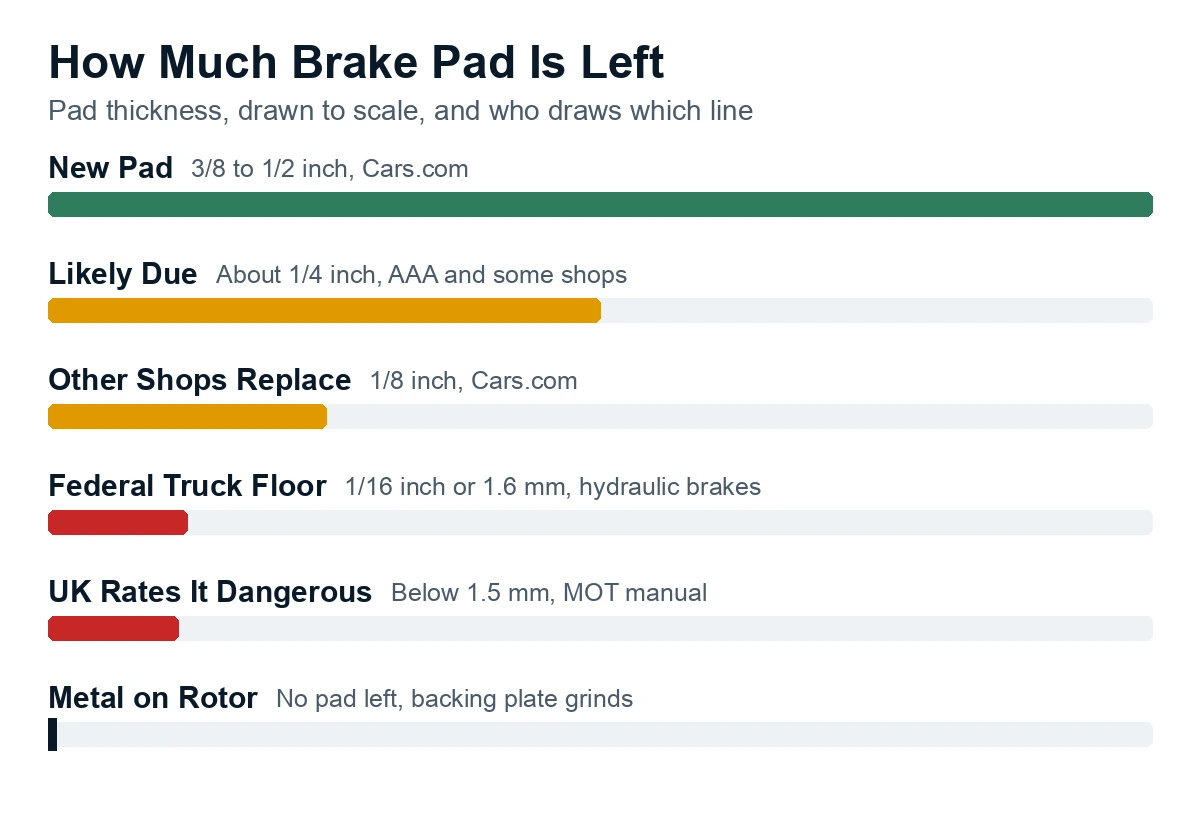
| Pad Left | Who Says | What It Means for You |
|---|---|---|
| 3/8 to 1/2 inch | Cars.com | A new pad, depending on the car. |
| About 1/4 inch | AAA and some shops | You likely need pads. Start planning. |
| 1/8 inch | Cars.com, other shops | The last line a shop will wait for. Book it now. |
| 1/16 inch, or 1.6 mm | Federal rule 49 CFR 393.47 | A commercial truck with hydraulic brakes can't run below this. It doesn't cover your own car, but it shows how thin is too thin. |
| Below 1.5 mm | UK MOT manual | Rated a dangerous defect in Britain. No California rule here, same physics. |
| Nothing left | Cars.com | The metal backing plate squeezes the rotor and usually ruins it. |
Cars.com also says some shops replace at 20 to 25 percent of the original thickness. On a 1/2 inch pad, 25 percent works out to 1/8 inch, so that rule lands in the same spot.
How Far You Can Drive, by Symptom
Nobody can give you a safe mile count without seeing the pad. Thickness, how hard you brake and the roads you drive all change it. Treat any number you hear as a guess.
What you can go by is the car. The middle column comes from AAA, the California DMV and Cars.com. The last column is Hemet Mechanic's shop judgment, not a law.
| What You Notice | What It Usually Means | The Call |
|---|---|---|
| A shop said pads are low, no noise, firm pedal | Pad left, but it's running out | Normal local driving while you book it this week. No mountain trips. |
| High pitched sound when braking | The wear indicator is touching the rotor, says AAA | Book within days. Short trips, easy stops, no towing. |
| Grinding | Very little pad left, and other parts are getting damaged | Stop driving it. Get it fixed where it sits. |
| Soft or sinking pedal | Lost hydraulic pressure, says the California DMV | Don't drive it, even to a shop. |
| Fluid leaking near a wheel | A brake warning sign on AAA's list | Don't drive it. |
| Car pulls to one side | A warning sign on AAA's list. A sticking slide or pin can also wear pads unevenly, per Cars.com | One short, slow trip at most. Get it seen right away. |
| Smoky smell | A warning sign on AAA's list | Pull over somewhere safe and let it cool. Don't go far until it's checked. |
| Brake light on the dash | Could be a wear light, low fluid or an ABS fault | Get it read before any long drive. If the pedal feels off too, park it. |
A squeal gets its own warning. The UK's MOT manual says some pads have metal indicators that touch the disc and squeal when the pad is too worn, and it rates a pad worn down to its indicator a major defect (UK MOT manual, section 1.1.13). Treat a squeal as a deadline.
Silence Doesn't Mean Your Pads Are Fine
Plenty of drivers figure no noise means no problem. The federal brake standard says otherwise.
Under FMVSS 135, a carmaker can show pad wear one of two ways. It can warn the driver with a sound or a light, or it can give you a way to check the wear by looking from outside or under the car (49 CFR 571.135, S5.1.2). So on some cars the only warning is someone looking.
Checking takes a few minutes with a flashlight.
- Park on level ground with the brakes cool.
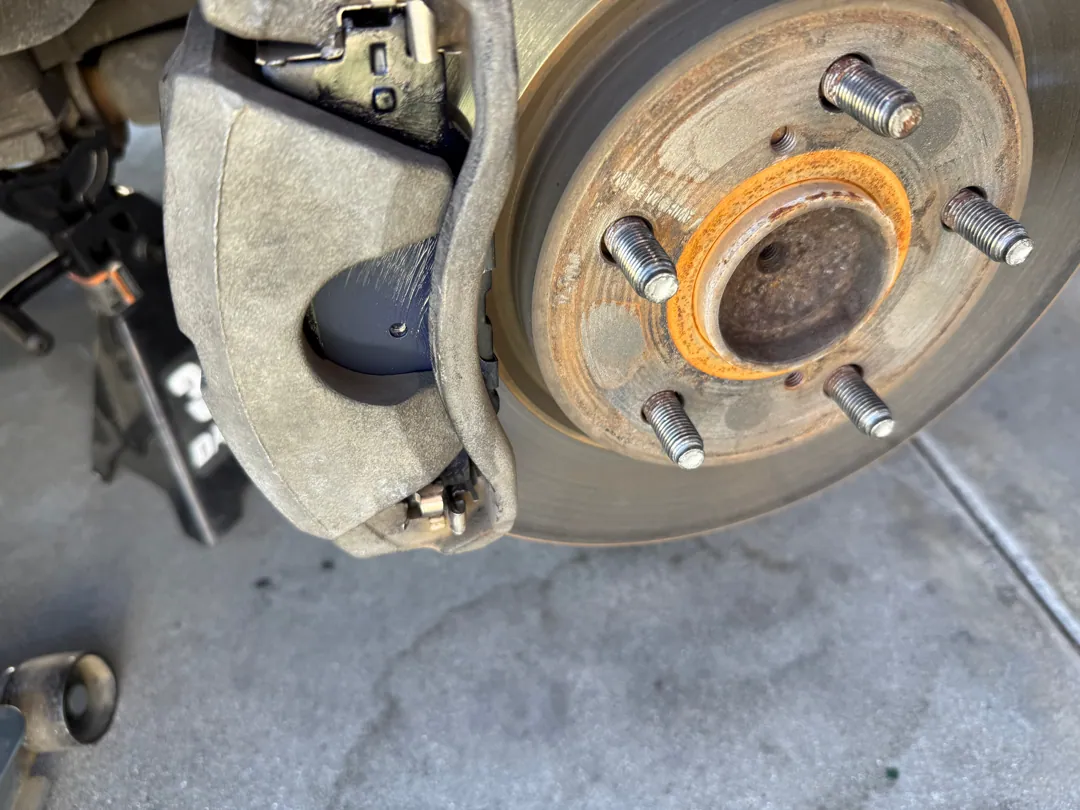
- Look through the wheel at the inspection hole on top of the caliper. Cars.com says some alloy wheels let you see the outer pad this way.
- Hold a ruler up to it, or compare it with a new pad. Under 1/4 inch, start planning.
- Check both sides of the car. Uneven wear is a clue that a slide or pin is sticking.
- Get the wheel off for a true reading. Cars.com says most cars need that for a good look.
California's own numbers back up looking. The Bureau of Automotive Repair counted 238,601 inspections started in its Vehicle Safety Systems Inspection program by September 28, 2025, with a 15.9% failure rate. The brake system is on its list of the most common failure reasons (BAR program update, October 2025). Those are cars sent for that state inspection, not every car on the road.
What Waiting Costs
A pad job that waits can turn into a pad and rotor job. Cars.com says the backing plate usually damages the rotor beyond repair once the pad is gone. AAA says driving on worn brakes can damage the whole brake system and wear down your tires.
Put a price on that. Data for Trades found shops that post prices online charge a median $180 an axle for brake pads, across 197 shops, and a median $312 for pads and rotors, across 82 shops. The gap is about $132 an axle. That's simple subtraction from two different groups of shops, so read it as a rough size and not a quote.
Prices vary a lot by shop. Hemet Mechanic's rate sheet lists a starting price of $125 an axle on sedans and $150 on trucks and SUVs, with pads, rotors and lubrication listed. The full breakdown is in Brake Job Prices in Hemet.
Highway 74 Is the Hemet Test
A flat run to the store is one thing. Highway 74 is another.
Hemet sits at 1,594 feet (Wikipedia, Hemet). Keen Camp Summit, just past Mountain Center on Highway 74, is at 4,917 feet (Wikipedia, State Route 74). Subtract and that's about 3,300 feet you have to come back down, on a winding road.
A downhill makes the brakes turn speed into heat, and a thin pad has less material left to take it. The California DMV warns truck drivers to watch for brake fade or failure on long grades. It says to pick a low gear before you start down, not after you've picked up speed, and to keep each brake press to about 3 seconds (California DMV, Truck Drivers). That guide is for trucks, but a loaded pickup or a car towing a trailer has the same problem on a smaller scale.
So the rule is simple. If your pads are near 1/8 inch or squealing, don't start up the hill. Idyllwild can wait for the brake job.
California Law on Worn Brakes
California Vehicle Code 26453 says all brakes and their parts must be kept in good condition and good working order (Section 26453).
Section 26454 sets a stopping test. From 20 mph on a hard, level, dry road, a passenger car with 10 or fewer seats has to stop within 20 feet. A pickup or other single vehicle rated 10,000 pounds or less gets 25 feet (Section 26454).
Neither section names a pad thickness. The law cares whether the brakes work, so a car can look fine on paper right up until it doesn't stop.
If It's Already Grinding
You don't need to drive a grinding car to get it fixed. Mobile mechanics do brake work where the car sits. Hemet Mechanic's brake repair page puts a driveway job at about an hour per axle.
Whoever you call, California's rules still apply. The shop must give you an estimate first, and you have to authorize the work before it starts. The Bureau of Automotive Repair's Auto Shop Locator lets you search by city and filter for mobile repairs (BAR, Maintenance and Repairs).
Last Few Questions
- Can I still drive if my brake pads are worn?
- For a short trip, if there's still pad left, the pedal is firm and there's no grinding. Book the repair right away. Once you hear grinding, or the pedal goes soft, stop driving and have it fixed where it sits.
- What happens if you drive a car with worn brake pads?
- Once the pad is gone, Cars.com says the metal backing plate gets squeezed against the rotor, which usually ruins the rotor. AAA adds that driving on worn brakes can damage the whole brake system and wear down your tires.
- How to check brake pad wear?
- Look through the inspection hole on top of each caliper with a flashlight. Cars.com says new pads are about 3/8 to 1/2 inch thick. On most cars a true reading needs the wheel off.
- How long can you drive with worn brake pads?
- No one can give you a safe mile count without seeing the pad. Thickness, how hard you brake and your roads all change it. Treat a squeal as days, not months, and grinding as zero.
- Is it illegal to drive with worn brake pads in California?
- California Vehicle Code 26453 says all brakes and their parts must be kept in good condition and good working order. Section 26453 and section 26454 don't name a pad thickness, so the test is whether the brakes work as the law requires.
- How much will 4 brake pads cost?
- Four pads usually means both axles. Hemet Mechanic's posted starting price for both axles is $250 on a sedan and $300 on a truck or SUV, with pads, rotors and lubrication listed, as of November 2026. Unusual vehicles get an exact quote first.
Links We Used
- Cars.com, How Do I Check the Pad Life on My Disc Brakes, published September 2018, accessed November 2026
- AAA, 11 Ways to Know You May Need New Brakes, accessed November 2026
- 49 CFR 571.135, FMVSS 135 Light Vehicle Brake Systems, accessed November 2026
- 49 CFR 393.47, Brake Linings and Pads, accessed November 2026
- UK Government, MOT Inspection Manual, Brakes, accessed November 2026
- California Vehicle Code 26453, accessed November 2026
- California Vehicle Code 26454, accessed November 2026
- California DMV, Truck Drivers Guide, accessed November 2026
- California Bureau of Automotive Repair, Maintenance and Repairs, accessed November 2026
- California Bureau of Automotive Repair, Vehicle Safety Systems Inspection Program Update, October 2025, accessed November 2026
- Wikipedia, California State Route 74 and Wikipedia, Hemet, California, accessed November 2026
- Hemet Mobile Mechanic price list and brake repair page, our posted rates, November 2026
More Like This
- Brake Job Prices in Hemet, 2026, Per Axle and Per Car
- Clunking Noise When Going Over Bumps?
- What a Mobile Mechanic Costs to Come Out
We do brakes in driveways across Hemet and the San Jacinto Valley, 7 days a week. If your pads are grinding, leave the car parked and call (951) 474-1277. We'll quote it before we start.