What the Smell Is Telling You
Brakes stop a car by turning its motion into heat. Pads squeeze the rotors, the rotors get hot, and the heat soaks into everything nearby.
A little heat is the job. Too much and the pad material starts to cook, which gives off that sharp, hot smell you notice through the vents.
AAA lists the usual brake causes as heavy braking, stuck calipers, worn out pads and leaking fluid (AAA Club Alliance). Where and when you smell it narrows it down fast.
| When You Smell It | Most Likely Cause | What to Do |
|---|---|---|
| Coming down a long grade | Pads and rotors overheated from steady braking | Low gear, pull over, let them cool |
| Right after you pull away from parking | Parking brake still on or not fully released | Check the lever, pedal or switch, then feel for one hot rear wheel |
| On flat roads, from one corner | A stuck caliper holding a pad against the rotor | Stop driving on it and have it checked |
| The first days after a brake job | New pads breaking in | Normal if it fades and the pedal feels right |
| Parked, from under the hood | Likely not the brakes. Belts, oil on the exhaust or wiring | Look for leaks and have it checked |
That last row matters. AAA also lists worn belts, oil dripping onto hot exhaust parts, leaking hoses and electrical shorts as burning smells. A smell that comes from one wheel after a drive points at the brakes. A smell from the engine bay with the car sitting still points somewhere else.
The Grade Down to Hemet
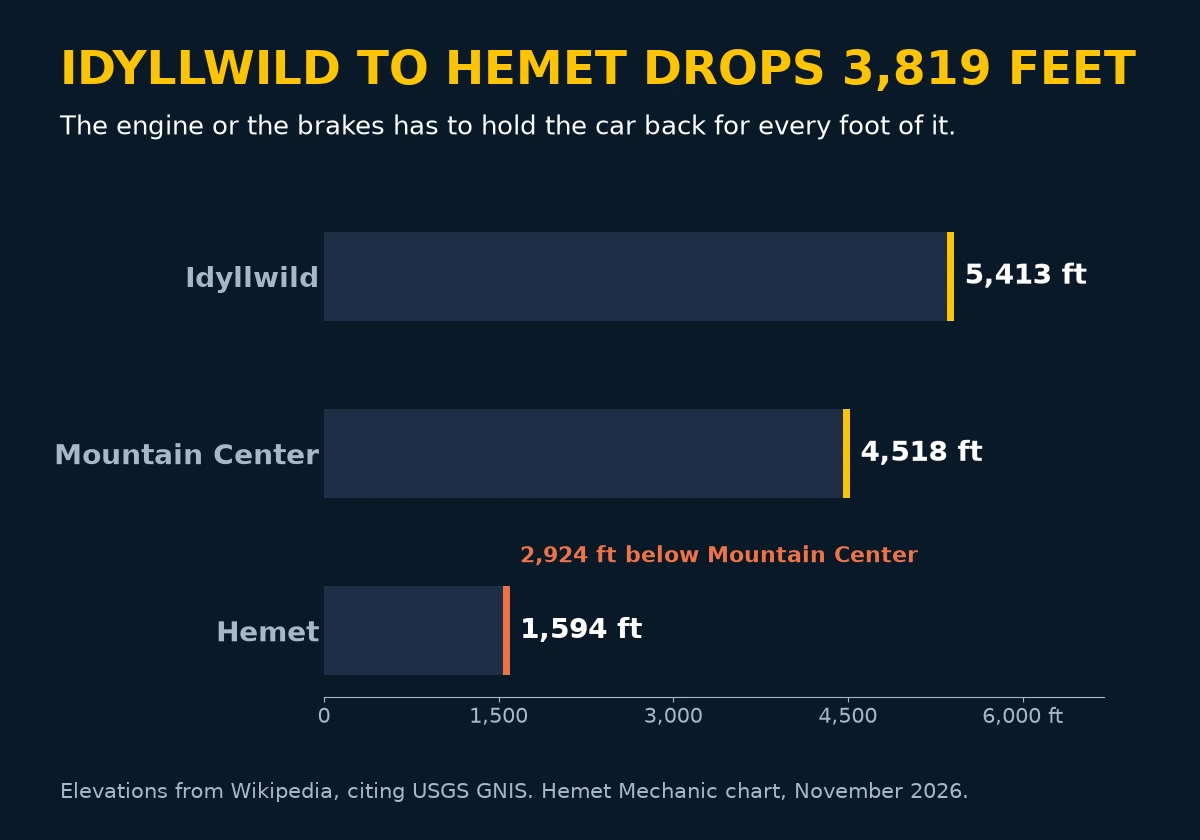
Idyllwild sits at 5,413 feet. Mountain Center, where Highway 243 meets Highway 74, sits at 4,518 feet. Hemet sits at 1,594 feet. That's 3,819 feet of drop from Idyllwild to town, and 2,924 feet of it is the run down Highway 74 from Mountain Center (elevations from Wikipedia, citing USGS).
Plenty of people drive it every day. Wikipedia notes most high school age kids in Idyllwild go to school in Hemet, about 35 miles and 3,000 feet each way.
Every foot of that drop is energy the car has to get rid of. Either the engine holds the car back or the brakes turn it into heat. Ride the pedal the whole way and the brakes take all of it.
The rule for it is short. The California Driver Handbook says to shift to low gear before going down a steep hill.
The owner's manuals say why. Buick's 2012 Enclave manual tells drivers to shift to a lower gear on steep or long hills, and warns that if you don't, the brakes could get so hot they would not work well (Buick Enclave owner's manual). The same page says coasting downhill in Neutral or with the engine off is dangerous.
That loss of grip from heat is brake fade. The pedal still moves, but the car doesn't slow the way it did at the top.
Your car may not have a shifter with numbers on it. Most automatics have an L, a 2, a manual mode or paddles. Some hybrids have a B position. Your owner's manual names the one for long downhills.
Smelled It on the Way Down
- Stop riding the pedal. Shift to a low gear and let the engine hold the car back.
- Slow down. Pick a speed the low gear can hold with only light touches of the brake.
- Pull over at the next safe turnout. Park well off the road, away from dry grass.
- Let them cool. Phoenix Friction tells drivers who are breaking in new pads that the odor fades after about 30 minutes of cooling (Phoenix Friction). Treat 30 minutes as the minimum after a hard descent, not the goal.
- Don't touch the wheels. Rotors and calipers can burn skin long after the smell fades.
- Test the pedal before you roll. It should feel firm and stop at the same height it always does.
If the pedal sinks to the floor, the DMV handbook says to pump the brakes, shift to a lower gear to slow down, then try the emergency brake. That's the plan for a brake that quits, not a reason to keep going.
Hot brake fluid that has pulled in water can boil, and a pedal that goes soft after a hot descent is the warning. Our post on when a brake fluid flush is due covers how old fluid gets there.
One Hot Wheel Means a Part, Not Your Driving
A smell on flat ground, around town, with nobody riding the brakes is a different problem. Something is holding a pad against a rotor when your foot is off the pedal.
The usual suspects, in the order a mechanic checks them.
- The parking brake. Left on, half set, or a cable or electric parking brake that doesn't fully release. The smell comes from the back.
- A sticking caliper. A piston or slide pin that won't let go keeps one pad dragging. AAA names stuck calipers as a common source of the smell.
- Worn out pads. Metal on metal runs hot. If it's grinding too, read our post on driving on worn brake pads.
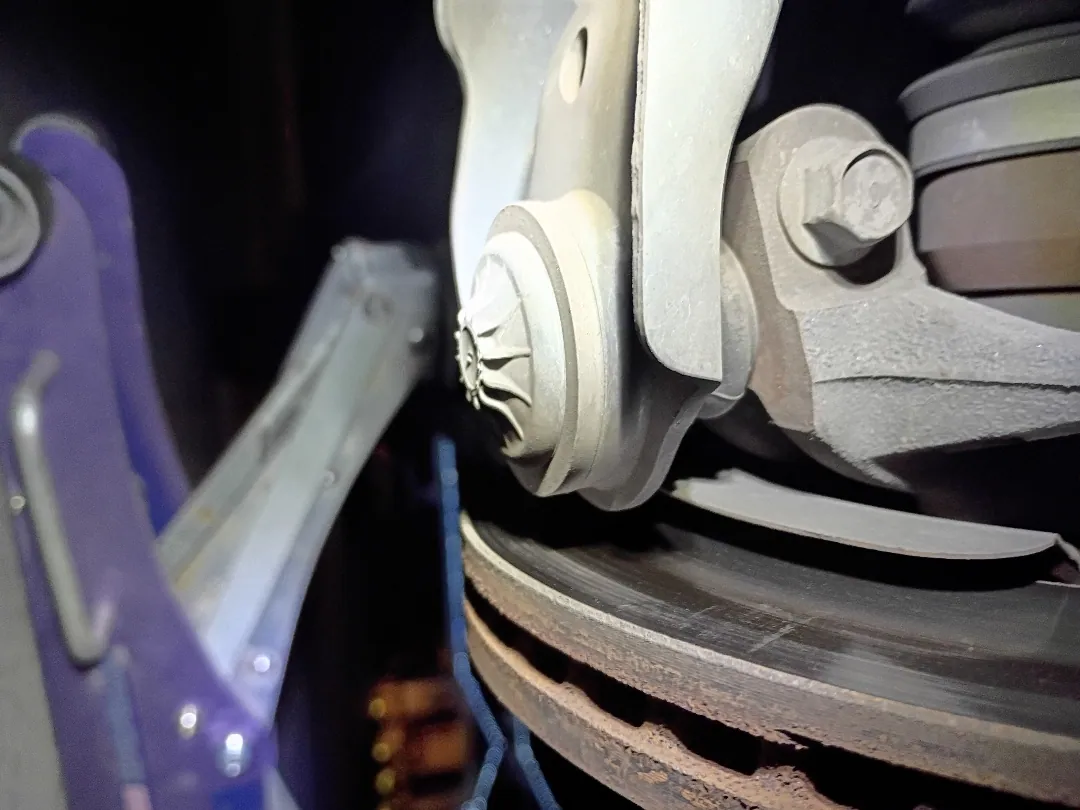
The clues for a stuck wheel are easy to spot. The car pulls to one side. One wheel is caked in more dust than the rest. After a short drive, one wheel puts off much more heat when you hold your hand near it, not on it.
A dragging brake doesn't fix itself. It keeps heating that one rotor and wearing that one set of pads, and it can cook the fluid on that corner.
People rarely write about the smell itself. Of the 23,409 auto repair reviews in our own review set, 743 mention brakes and just one describes a burning smell. That driver had just come down off the mountains near Palm Springs. Most people call the shop before they ever write about it.
New Brakes That Smell
Fresh pads give off a smell while they break in. Phoenix Friction calls it de-gassing and says the odor is normal.
Break in, also called bedding, lays a thin, even layer of pad material onto the rotor. Les Schwab's steps are five firm stops from 35 mph down to 5 mph, then two to five hard stops from 45 mph down to 5, then about 10 minutes of driving with little braking before you let them cool (Les Schwab). Do it on an empty, straight road.
The part that matters around here comes after. Les Schwab says not to ride your brakes down hills, tow or carry a heavy load for the first 1,000 miles or more. Just had brakes done? Save the drive up to Idyllwild for a few weeks.
When is a smell after a brake job a problem? When it keeps coming back past the first few hundred miles. When it comes from one wheel. When the car pulls, the pedal feels soft, or you see smoke. Any of those means something didn't seat right and the job needs a second look.
What the Fix Costs in Hemet
Most brake smells cost nothing but a cool down. When a part caused it, the fix depends on what's dragging. These are the starting prices posted on the Hemet Mechanic prices page in November 2026.
| What Turned Up | What Usually Gets Done | Our Posted Starting Price |
|---|---|---|
| Smell after one hard descent, pedal fine | Nothing, or a look at pad and rotor wear | Often nothing. $150 an hour if you want it checked |
| Pads glazed or rotors heat marked | Pads and rotors on that axle | $125 an axle for sedans, $150 an axle for trucks and SUVs |
| One wheel dragging | Find the stuck caliper, hose or parking brake, then fix it | $150 an hour to find it, then a written quote |
| Soft pedal after a hot run | Check the fluid and bleed or flush it | $150 an hour, then a written quote |
The axle price covers pads, rotors and lubrication, about an hour an axle. Every job gets a quote before work starts. The full breakdown by car type is in our Hemet brake job prices post, and the brake repair page lists what's included.
A dragging brake that's caught early is often one part on one corner. Driven on for weeks, it can take the pads, the rotor and the fluid on that corner with it.
Last Few Questions
- Is it safe to drive if my brakes smell like burning?
- Not right away. Pull over where it's safe and let the brakes cool. If the pedal feels normal after that and the smell is gone, drive gently in a low gear. If the pedal sinks, the car pulls, or you see smoke from one wheel, don't drive it. Have it checked where it sits.
- How long does it take for new brake pads to stop smelling?
- A light smell during the first stops is normal. Phoenix Friction says the odor from break in fades after the brakes cool for about 30 minutes. A smell that keeps coming back after the first few hundred miles, or comes with a pull or a soft pedal, points to a problem.
- Can a stuck parking brake cause a burning smell?
- Yes. A parking brake left on, or one that doesn't fully release, drags the rear pads or shoes the whole drive. The smell usually comes from the back of the car, and one rear wheel runs much hotter than the others.
- Why do my brakes smell after driving downhill?
- Holding the brakes on a long grade turns the car's motion into heat in the pads and rotors. The California Driver Handbook says to shift to low gear before going down a steep hill, so the engine holds the car back and the brakes stay cooler.
- Do pads need to be bedded again after changing rotors?
- Yes. New rotors and new pads both need a break in so the pad lays an even layer on the rotor. Les Schwab's steps are five firm stops, a few hard stops, a cool down, and no hard braking or riding the brakes down hills for about the next 1,000 miles.
- What else smells like burning if it isn't the brakes?
- AAA lists worn rubber belts, oil leaking onto hot exhaust parts, leaking hoses and electrical shorts. A smell from under the hood with the car parked points away from the brakes. A smell from one wheel after driving points at them.
Links We Used
- eCFR, 49 CFR 571.116, FMVSS 116 Motor Vehicle Brake Fluids, accessed November 2026
- California DMV, California Driver Handbook, Safe Driving, accessed November 2026
- Wikipedia, Idyllwild, Pine Cove, and Fern Valley, accessed November 2026
- Wikipedia, Mountain Center, California, accessed November 2026
- Wikipedia, Hemet, California, accessed November 2026
- Buick, 2012 Enclave Owner's Manual, Hill and Mountain Roads, accessed November 2026
- AAA Club Alliance, Why Does My Car Smell Like Burning Rubber, January 29, 2024, accessed November 2026
- Phoenix Friction, Bedding In Process for Brake Pads and Rotors, accessed November 2026
- Les Schwab, How to Bed In New Brake Pads and Rotors, December 22, 2025, accessed November 2026
- Hemet Mobile Mechanic prices page, our posted rates, November 2026
More Like This
- Brake Job Prices in Hemet, 2026, Per Axle and Per Car
- Worn Brake Pads, Book at 1/8 Inch, Stop Driving at Grinding
- Brake Fluid Flush, Due at 2 Years on Some Cars, 10 on Others
We check brakes in driveways across Hemet and the San Jacinto Valley, 7 days a week, and we'll tell you which wheel is hot before we quote a thing. If your brakes smelled on the way down the hill this week, call (951) 474-1277.