Why Hemet Is Hard on Batteries
AAA says a car battery lasts three to five years. In cooler northern areas it may go five years or more. In hot southern places it typically lasts about three (AAA, How Long Do Car Batteries Last).
Consumer Reports adds the regional numbers it credits to AAA. Batteries average 58 months or longer in the far north of the country and less than 41 months in the far south (Consumer Reports).
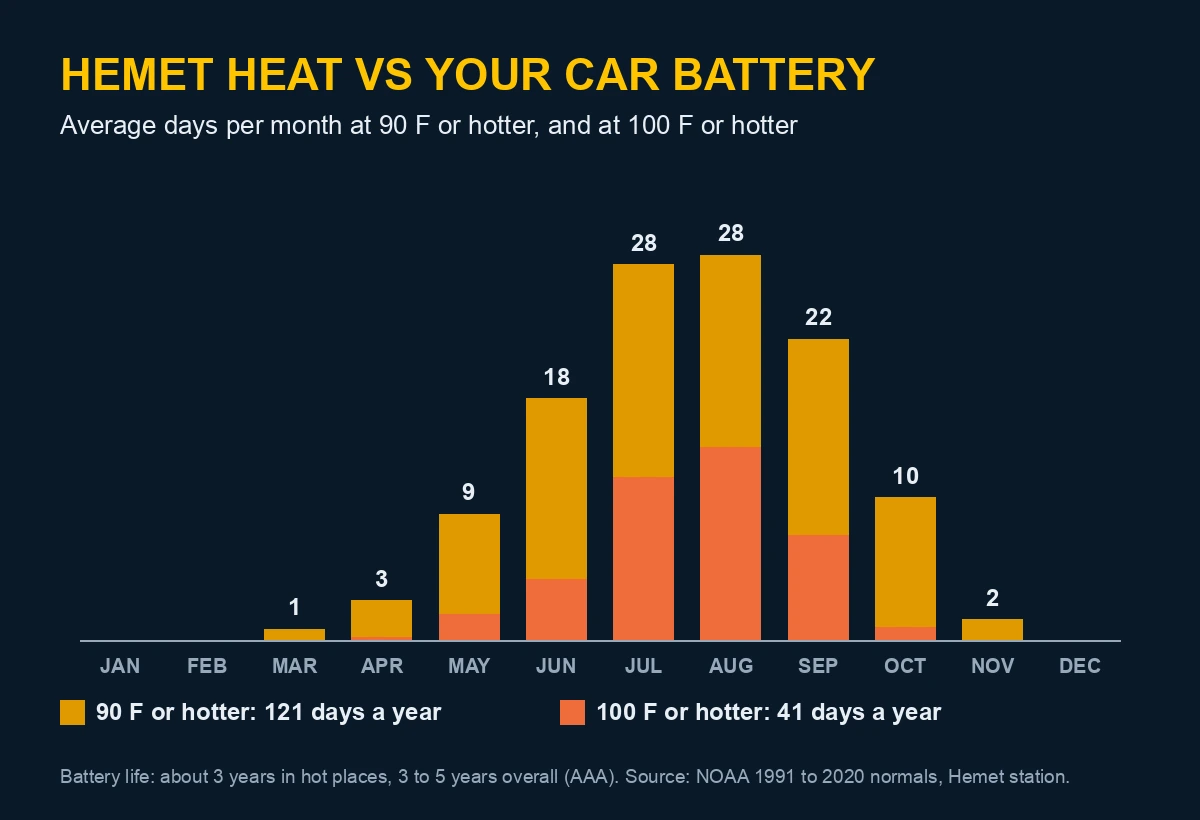
Hemet sits on the hot end of that range. The NOAA normals for the Hemet station show the heat stacks up for half the year.
| Month | Average High | Days at 90 F or More | Days at 100 F or More |
|---|---|---|---|
| May | 80.8 F | 9.3 | 1.9 |
| June | 89.1 F | 17.8 | 4.5 |
| July | 95.6 F | 27.7 | 12.0 |
| August | 96.7 F | 28.4 | 14.2 |
| September | 92.2 F | 22.2 | 7.7 |
| October | 82.4 F | 10.5 | 0.9 |
| Whole year | 79.5 F | 121.3 | 41.4 |
That is outside air. Under the hood it gets far worse. AAA says engine bay temperatures can easily pass 200 degrees in hot weather, and that heat speeds up how fast a battery wears out (AAA).
Consumer Reports tests for exactly this. Its lab life test holds batteries above 167 degrees for 15 weeks, because heat is what ages them (Consumer Reports). An August afternoon parked at a Florida Avenue lot is a smaller version of that test, run again every summer.
Summer Kills It, January Gets the Blame
Most people in the Valley find out their battery is done on a cold morning, not a hot one. That fools them into thinking cold killed it.
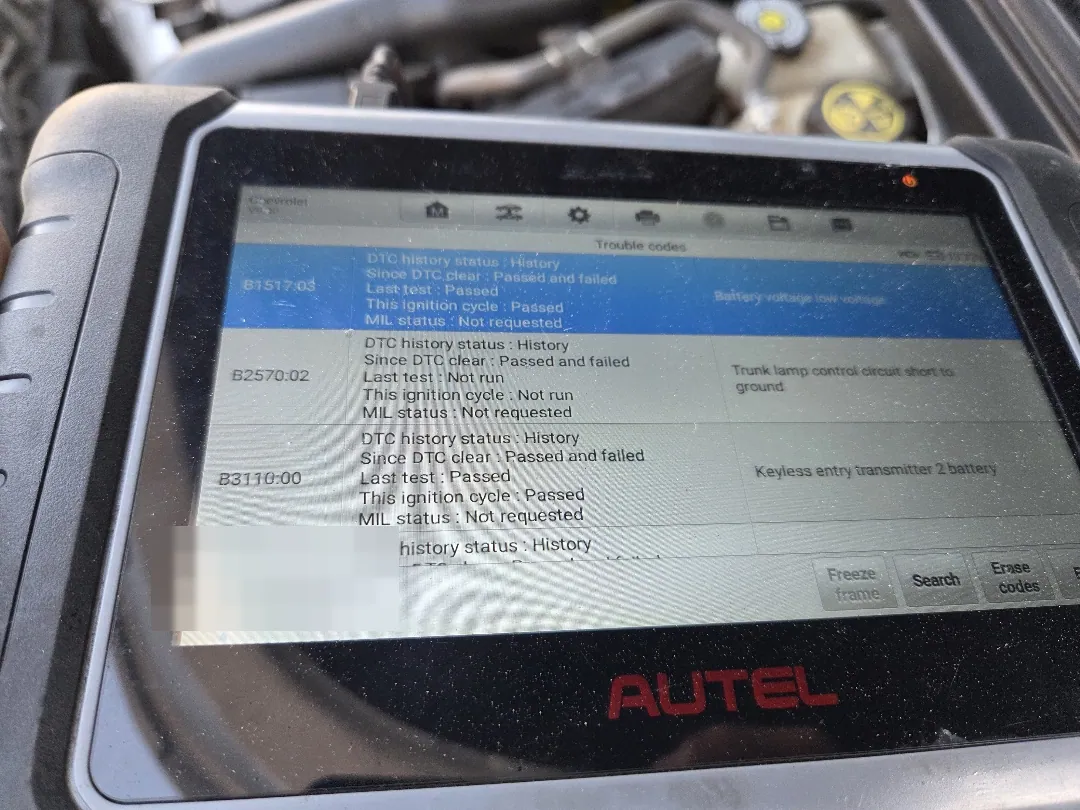
It didn't. Heat did the damage months earlier. Cold just stops hiding it. Interstate Batteries says warm temperatures and routine drives can mask a weak battery. It also says a new battery rated at 500 cold cranking amps could test at 600 or more at 70 degrees, and should test close to its label at 0 degrees (Interstate Batteries).
So a battery that barely has enough in August still starts the car, because warm batteries deliver more. Then the nights drop. Hemet's average January low is 44.2 degrees and December's is 43.1 (NOAA climate normals). The same tired battery now comes up short.
That's why late October and November are the time to test. You catch the weak battery after the heat has done its work, before the first cold morning in a parking lot.
A Battery Plan by Age
AAA says to have a battery tested every year once it reaches its third year, and to look at it at every oil change (AAA). Consumer Reports goes one year sooner for warm climates. It says to load test every year after the battery turns two (Consumer Reports). With 121 hot days a year, use the warm climate rule.
| Battery Age | What to Do in Hemet |
|---|---|
| New to 2 years | Look at the terminals and hold down at each oil change. Clean any white or green crust. |
| 2 years | First load test. Do it in fall, after the summer heat. |
| 3 years | Test twice a year, before summer and before winter. Interstate says twice a year for every battery. |
| 3 years and slow cranks | Plan the replacement now, on your schedule, not a tow truck's. |
| Any age, warning light | Test the battery and the alternator the same day. A good battery on a bad charging system dies again. |
AAA lists the signs to watch. The starter cranks the engine slowly. The battery or charging light comes on. On older cars with plain bulbs, the headlights go dim at idle (AAA).
Not sure where the date is? Most batteries carry a sticker or stamp with the month and year. Consumer Reports shows codes like 7/25 for July 2025 (Consumer Reports). If you bought the car used and can't find one, treat the battery as old until a test says otherwise.
Check It Yourself With a Meter
A basic multimeter gives you a first look in two minutes. Set it to DC volts and put the red lead on the positive post and the black on the negative.
- Knock off the surface charge. Interstate says to run the headlights for about two minutes with the engine off first, so the reading isn't falsely high (Interstate Batteries).
- Read it resting. Lights off, engine off.
- Read it running. Start the car and read again at idle.
| Reading | What It Tells You |
|---|---|
| 12.6 to 12.8 volts, engine off | Full charge on a standard flooded battery, per Optima. Some AGM batteries rest higher, about 13.0 to 13.2. |
| Below 12.4 volts, engine off | Low. Optima says a battery left sitting below this starts to sulfate, which costs it capacity and life. |
| Over 13 volts, engine running | The alternator is charging. Interstate's line is 13 volts. |
| Under 13 volts, engine running | Interstate says that points to a bad alternator or a bad battery. Get the charging system tested. |
The resting numbers come from Optima's heat guide (Optima Batteries). Know the limit of a meter, though. Voltage shows charge, not strength. A battery can read 12.6 and still fail a load test, because heat wears down how much current it can push. Interstate says a shop's full test checks reserve capacity and the battery's inner condition, which a meter can't see.
A real test also checks the other half. Hemet Mechanic's mobile diagnostics cover starters and charging systems, so the alternator gets tested with the battery, in your driveway.
Make the Next One Last Longer
You can't move Hemet. You can cut how much of that heat reaches the battery and keep it charged.
- Park in shade or a garage when you can. Consumer Reports notes heat harms the battery even when the car just sits.
- Keep the cable ends clean and tight and the hold down snug. AAA says so, and Consumer Reports says to clear dirt and corrosion off the posts.
- Drive at least 20 minutes at a time now and then. Consumer Reports says trips that long refill the battery.
- Use a battery maintainer if the car sits more than a week. Consumer Reports suggests a minder or smart charger.
- Don't run the radio or lights with the engine off. Consumer Reports says that drains the battery.
- Think about AGM. Consumer Reports says AGM batteries tend to do better than other sealed batteries in its tests, even though heat still affects them.
- Buy a fresh one. Consumer Reports says to buy a battery less than six months old, and ideally three months or newer. Check the date code on the shelf.
One more Valley tip. Some newer cars, including some Audi, BMW, Ford and Mercedes models, may need the new battery registered with the car so it can set its charging to match (Consumer Reports). Ask about it before you swap one in.
A new battery also wipes your emissions self tests. If a smog check is coming, California's Bureau of Automotive Repair says to drive for a week or two after a battery is disconnected or replaced (BAR, Smog Check). The full story is in the smog and check engine light post.
What a Dead Battery Costs You
The battery itself is the smaller bill. The surprise costs come from when it dies.
- The state fee. California charges a $2 battery fee on every replacement lead acid battery. The store collects it at the register (CDTFA tax rates).
- The testing. Hemet Mechanic's posted mechanic and diagnostic rate is $150 an hour as of October 2026, on the price list. Every job is quoted before work starts.
- The timing. A battery replaced on a Tuesday afternoon costs the battery. One that dies in the Stater Bros lot at 7 at night costs a jump, a ride, maybe a tow, and a lost evening.
Heat hurts more than the battery, too. If your temperature gauge also climbs on hot days, read why a car overheats, cheapest causes first.
Last Few Questions
- How long does a car battery last in hot weather?
- About three years. AAA says batteries typically last about three years in hot southern places and five or more in cooler northern ones. With 121 days a year at 90 degrees or more, Hemet is on the hot side.
- Do car batteries go bad in hot weather?
- Yes. AAA says heat speeds up how fast a battery wears out. The damage often stays hidden until the first cool morning, when the weak battery can't start the car.
- What temperature is too hot for a car battery?
- There's no single cutoff. Wear speeds up as it gets hotter. AAA says engine bay temperatures can pass 200 degrees in hot weather, and Consumer Reports ages batteries in its lab at over 167 degrees.
- Is a 20 minute drive enough to charge a car battery?
- It helps keep a healthy battery topped up. Consumer Reports suggests trips of 20 minutes or longer. A battery that is deeply drained needs a real charger or a test, not just a drive.
- How often should I test my car battery in Hemet?
- Every year once it's two years old, following the Consumer Reports advice for warm climates. At three years and up, test before summer and again before winter.
Links We Used
- NOAA National Centers for Environmental Information, U.S. Climate Normals 1991 to 2020, Hemet station USC00043896, accessed October 2026
- AAA, How Long Do Car Batteries Last, accessed October 2026
- Consumer Reports, How Hot Weather Affects Your Car Battery, updated June 2026, accessed October 2026
- Interstate Batteries, When Your Car Battery Is at Death's Door, accessed October 2026
- Interstate Batteries, How to Test a Car Battery, accessed October 2026
- Optima Batteries, What Does Heat Mean for Car Batteries, accessed October 2026
- California Department of Tax and Fee Administration, special taxes and fees rates, accessed October 2026
- California Bureau of Automotive Repair, Smog Check, accessed October 2026
- Hemet Mobile Mechanic price list, our posted rates, October 2026
More Like This
- Why Is My Car Overheating? 10 Causes, Cheapest First
- Can You Pass Smog With the Check Engine Light On?
- What a Mobile Mechanic Costs to Come Out
We test batteries and charging systems in driveways across Hemet and the San Jacinto Valley, 7 days a week. Slow crank or a battery light? Call (951) 474-1277.