First, Check That Your Car Has a Pump
A lot of people search for a pump price on a car that doesn't have one.
There are three kinds of power steering. The old kind uses a pump turned by a belt off the engine. Electric power steering, called EPS, uses an electric motor and a computer in place of a hydraulic system. A third kind, electro hydraulic, still has fluid and a pump, but an electric motor spins the pump instead of a belt (Wikipedia, Power steering).
Electric steering has been around longer than most people think. The first one on a mass produced car showed up in 1988, and it saves fuel because no pump runs all the time whether you're turning or not.
The quick way to tell what you have.
- Pop the hood. A belt driven system has a small fluid reservoir, often sitting on top of the pump, with lines running to it.
- Find the fluid in your owner's manual. If the manual lists power steering fluid, you have a hydraulic system. If it doesn't list any, you likely have electric steering.
If your car steers by motor, a heavy wheel is a different repair. It's an electrical problem that starts with a scan, not a pump. Our diagnostics page covers what a full scan includes.
Is It the Pump or Something Cheaper?
Most power steering noise is not a bad pump.
Mike Mavrigian, writing for Vehicle Service Pros, calls low fluid the most common cause of power steering noise. He also warns against blaming the pump before you've ruled out everything around it.
| What You Hear or Feel | Most Likely Cause | Check This First |
|---|---|---|
| High screech on startup or a sharp turn | A worn or loose drive belt | Belt cracks, glazing and tension |
| Whine that gets louder as you turn | Low fluid, often from a leak | The level at the cold mark, then look for wet hoses |
| Whine or groan with foamy fluid | Air in the system | A loose return hose clamp or a bad O ring pulling in air |
| Dark or murky fluid | Worn out fluid | A flush with the fluid your maker calls for |
| Whine at all times, even going straight | A worn pump bearing, or the alternator next to it | The belt off test below |
| Heavy wheel with no noise | A failing pump, a rack problem, or electric steering | Fluid level, then a pressure check or a scan |
The belt off test is the one that settles it. Mavrigian says to take the drive belt off and run the engine for a moment. If the noise stops, the pump is the source. If it keeps going, look at the alternator and the other parts the belt turns.
NAPA Know How adds that a slipping belt can make the whine, and air pockets can make the pump noisy too. Both are cheaper fixes than a new pump.
What It Costs, National Numbers and a Real Ticket
Most of the bill is the part. RepairPal puts parts at $632 to $633 and labor at $209 to $307, before tax and fees. Kelley Blue Book lands almost on top of it, at $842 to $941.
The average hides a wide spread by car. These are RepairPal's own ranges for common models, next to one pump job from our own job records.
| Car or Source | Parts and Labor | Where It Comes From |
|---|---|---|
| Ford F-150 | $498 to $615 | RepairPal |
| Toyota Corolla | $664 to $748 | RepairPal |
| Toyota Camry | $678 to $782 | RepairPal |
| Chevrolet Silverado 1500 | $748 to $850 | RepairPal |
| Honda Civic | $947 to $1,059 | RepairPal |
| Honda Accord | $1,002 to $1,058 | RepairPal |
| Honda CR-V | $1,424 to $1,470 | RepairPal |
| Nissan Altima | $1,823 to $1,893 | RepairPal |
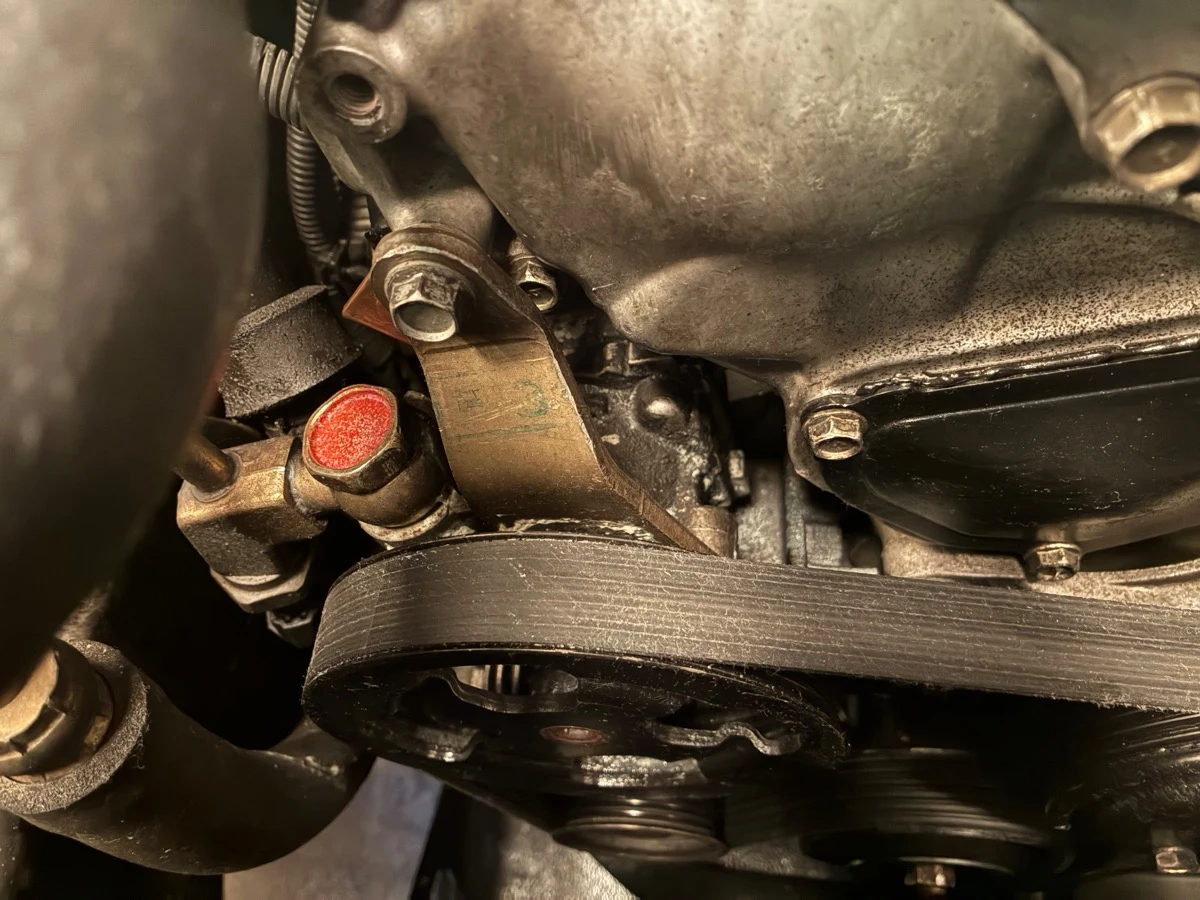
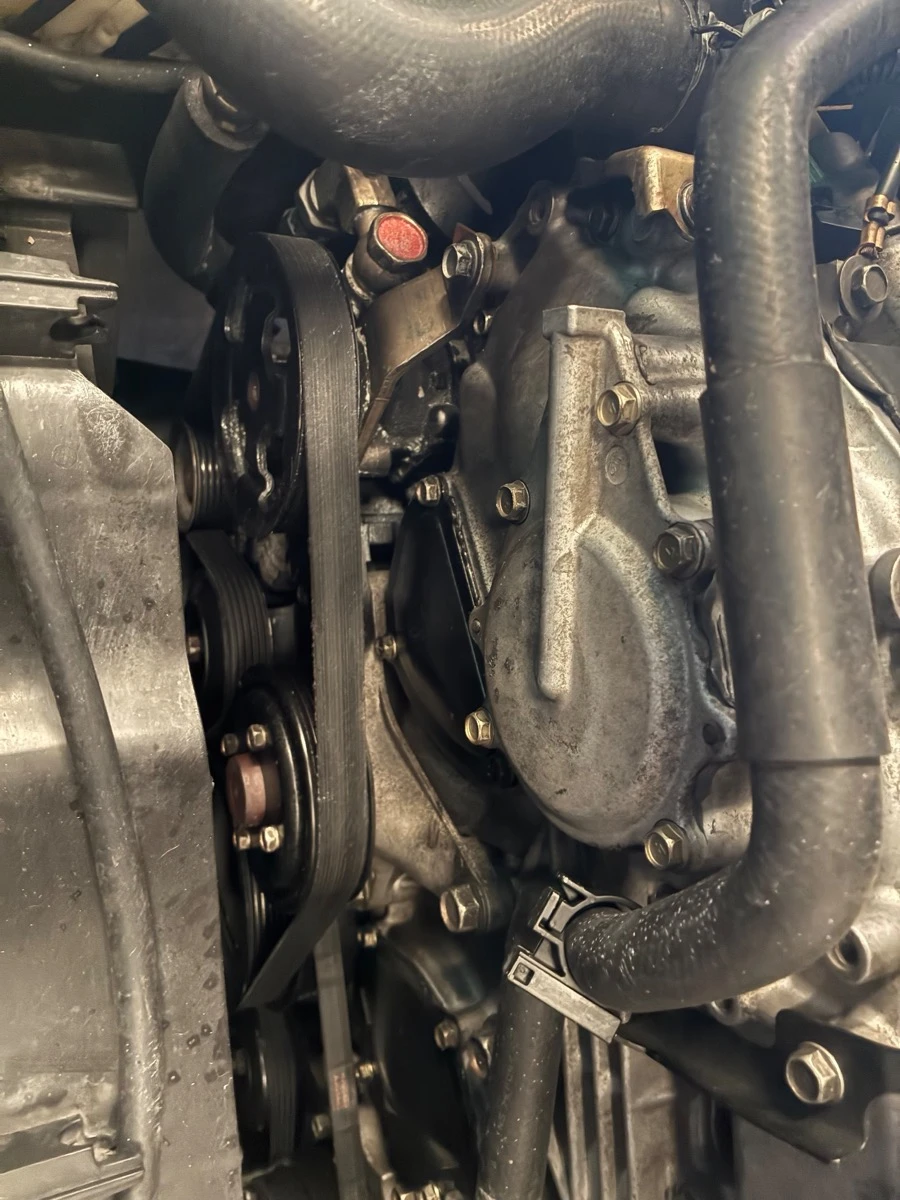
| 2005 Nissan 350Z, November 2026 | $505.99 before tax | Our job record. 2 hours at $150 plus a $205.99 remanufactured pump |
That 350Z came in squealing. The bearing inside the pump was going out. The fix was a remanufactured pump and two hours of labor, $300 for the labor and $205.99 for the pump. That's well under the national average, and the remanufactured part is most of the reason.
Two things move your price more than anything else. One is the part, new, remanufactured or factory. The other is how deep the pump sits. On some engines it's right up front. On others half the front of the engine comes apart to reach it.
Our prices page lists a power steering pump replacement at $169.99 per car, with diagnosis of the bad part included. Like every rate on that page, it's a starting rate for common setups. Unusual cars get an exact quote before any work starts, the same as the 350Z did.
Remanufactured or New, and the Core Charge
A remanufactured pump is a used pump that was rebuilt to work like new. It usually costs a good deal less than a new one, and it's what most shops put on an older car.
California has rules for this that protect you. The Bureau of Automotive Repair's consumer guide spells them out.
- You get a written estimate first. By law the shop has to give you one before doing any work, and it lists the parts and the method of repair.
- The invoice names rebuilt parts. It has to show an itemized list of parts and say which ones are used, reconditioned or rebuilt.
- You can ask for your old pump. Say so when you sign the estimate. The shop only has to return old parts if you ask before the work is done.
- The core charge. With a rebuilt part, the old one usually goes back to the supplier as partial payment. That's the core. If you want to keep your old pump, you may have to pay the core charge.
- A bigger bill needs your OK. If the job turns out to cost more than the estimate, the shop has to call, explain it and get your permission first.
When the shop replaces a pump, the system gets drained, refilled and bled of air. RepairPal also says it's often smart to replace the plastic reservoir at the same time, and that debris in the system can mean new hoses and a flush of the rack.
Driving on a Bad Pump
You can still steer. You just have to work for it.
Power steering only helps you turn. When the help is gone, the car can still be steered by hand, but the wheel feels much heavier, and Wikipedia notes that losing it can change how the car handles. That holds for electric systems too, which keep a mechanical link as a backup.
The heavy wheel is worst at parking lot speeds. Backing into a tight spot off Florida Avenue feels like a workout. On the highway it may barely show.
What makes it risky.
- A pump running dry. A leaking system that runs out of fluid keeps grinding the pump, and the bill grows.
- A shared belt. On many cars the belt that turns the pump also turns the alternator, and often the water pump. A seized pump can throw that belt and take your charging, and sometimes your cooling, with it.
- A wheel that goes heavy mid turn. A sudden loss of assist in a turn catches drivers off guard.
Keep the fluid at the mark, keep the trips short and get it checked soon. If the belt is squealing, cracked or gone, don't drive it. Our cooling system page covers what we check when a car starts running hot.
Where Pump Jobs Go Wrong
Reviews that mention a power steering pump run worse than the average repair review, though the count is small. Of the 23,409 auto repair reviews in our own review set, 18 mention a power steering pump by name. 6 of those 18 are one or two stars. Across the whole set, about 11 percent are.
The bad ones fall into a few patterns, and each one has a fix you can ask for.
- The pump got blamed for a rack problem. One driver paid for a pump, kept the same stiff wheel, then paid for a rack too. Ask how the shop knows it's the pump. A belt off test or a pressure check is a real answer.
- A leak came right back. A new pump won't stop a leaking hose. Ask the shop to name where the fluid is coming from before you approve a pump.
- A big quote for pump and rack together. Sometimes both are bad. Ask for each one priced on its own line, which the written estimate rule already gives you.
- The new pump failed fast. Ask what warranty the part carries and who handles it.
The good reviews have a pattern too. People liked a pump swapped right where the car sat, done the same day.
Last Few Questions
- Is it worth replacing a power steering pump?
- Usually, yes. It's a fixed part with a known price, and RepairPal's national average is $841 to $940. On an older car a remanufactured pump can cut that a lot. It isn't worth it when the real problem is a belt, low fluid or the rack, so get the cause confirmed first.
- Can I still drive with a bad power steering pump?
- For a short trip, carefully. The car still steers by hand, but the wheel gets heavy, most of all at low speed. Don't drive it if the belt is broken or squealing hard, since that same belt often runs the alternator and water pump.
- What are the signs of a power steering pump going out?
- A whine that won't go away even with the fluid full, a heavy wheel, foamy fluid, or a leak at the pump itself. A whine that stops when the belt comes off points at the pump. One that keeps going points at the alternator or another belt driven part.
- How long does it take a mechanic to replace a power steering pump?
- It depends on how deep the pump sits. Our 2005 Nissan 350Z job billed two hours of labor. Some cars take less, and some take more when other parts have to come off first. Bleeding the air out of the system adds a little time at the end.
- Can you use brake fluid as power steering fluid?
- No. Common brake fluids like DOT 3 and DOT 4 are glycol based, and most power steering fluid is mineral oil based, close to automatic transmission fluid. Vehicle Service Pros says to use only the fluid your maker calls for, since the wrong one can cause foaming and seal damage. If it already went in, the system needs a flush.
- Can I just refill my power steering fluid?
- You can top it off to the mark with the fluid your owner's manual names. If it keeps dropping, there's a leak, and topping it off only buys time. NAPA Know How says dark or murky fluid should be replaced, not topped off.
Links We Used
- RepairPal, Power Steering Pump Replacement Cost Estimate, estimates updated September 3, 2026, accessed November 2026
- Kelley Blue Book, Power Steering Pump Replacement Costs, accessed November 2026
- Wikipedia, Power Steering, accessed November 2026
- Wikipedia, Brake Fluid, accessed November 2026
- Mike Mavrigian, Diagnosing Steering System Noises, Vehicle Service Pros, August 4, 2017, accessed November 2026
- Benjamin Hunting, Power Steering Whine, NAPA Know How, January 22, 2018, accessed November 2026
- California Bureau of Automotive Repair, A Consumer's Guide to Auto Repair, accessed November 2026
- Hemet Mobile Mechanic prices page, our posted rates, November 2026
More Like This
- Clunking Noise When Going Over Bumps?
- How Much Does It Cost for a Mobile Mechanic to Come Out?
- What Is the Most Expensive Part of a Car to Repair?
We work on steering in driveways across Hemet and the San Jacinto Valley, 7 days a week, and we'll tell you whether it's the pump, the belt or the fluid before we quote a thing. If your wheel got heavy or started to whine this week, call (951) 474-1277.